
 Facebook
 X
 Pinterest
 Copy Link
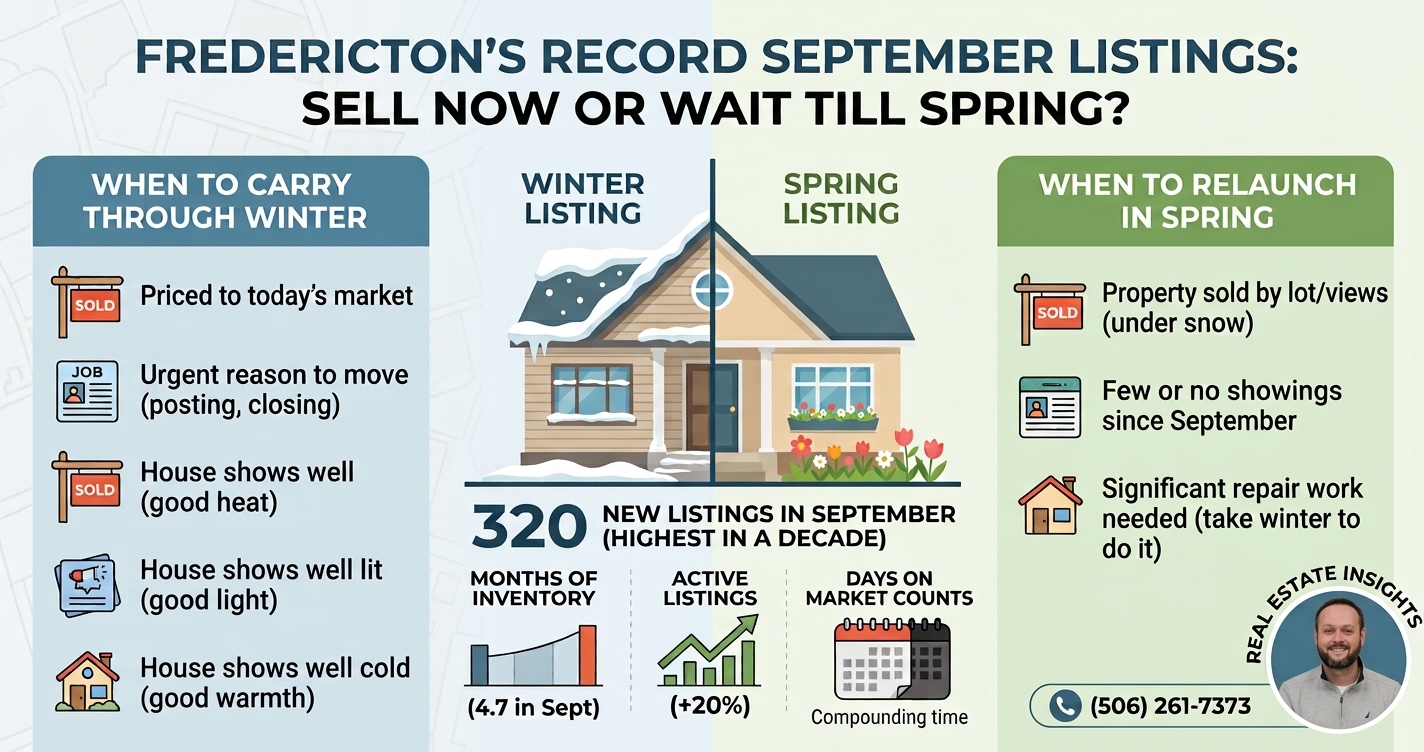
In September, 320 homes came onto the market in the Fredericton region. That is the highest new-listing count for any September in the board’s ten-year series.
Those listings do not evaporate when the weather turns. Most of them are still out there, and a good number of the sellers behind them are now working through the same question: do I carry this through the winter, or do I come off and try again in the spring?
There is no single right answer. But there is a wrong way to decide it, which is by the calendar alone.
What the September numbers actually say
The headline figures are on the market update page, which I rebuild every month. The three that matter for this decision:
Inventory moved from 3.4 months in August to 4.7 months in September. That is the clearest signal in the whole release. A year ago it was 3.5. Buyers have choice again in a way they have not had for several years.
There were 747 active listings at month end, about 20% more than a year earlier. More competition for every showing.
Sale-to-list has drifted from 99.0% to 98.4% over the year. Small, but it is moving in one direction, and it tells you buyers are negotiating rather than simply accepting.
What has not happened is a price drop. The MLS® HPI benchmark was $364,400, up 4.4% on the year. Supply loosened. Prices did not fall.
The question is not “is winter a bad time to sell”
I get asked that every October and it is the wrong frame.
Yes, fewer people shop in January than in June. But fewer people list in January too, and the buyers who are out in a Fredericton February — boots on, scraping the windshield at 7am to make a showing — are not browsing. Nobody tours a house in that weather for entertainment. The traffic drops; the seriousness of the traffic goes up.
The better question is narrower: what is it costing me to keep this particular listing on the market?
Days on market are the thing that compounds
A listing that went up in mid-September and is still active in January is carrying four months of days on market, and that number is the first thing a buyer’s agent looks at after the price.
It does not matter that December was quiet. It does not matter that the house is lovely. A long days-on-market number reads as something is wrong with this one, and the buyer starts from the assumption that there is a deal to be had. Median days on market across the region is 28. A listing at 120 is being read against that.
That is the real cost of carrying, and it is why “we’ll just leave it up and see” is the most expensive decision available. It is not neutral. It is accumulating.
When carrying through the winter is the right call
You are priced to today, not to last spring. If your price reflects 4.7 months of inventory rather than the market you watched your neighbour sell into eighteen months ago, winter is survivable. If it does not, winter will not fix it — it will just add days.
You need to move for a reason that has a date on it. A posting, a job, a closing on something you have already bought. Waiting has its own cost in that situation, and it usually exceeds the seasonal one.
The house shows well cold. Good heat, warm light, a dry basement, a driveway that gets cleared. Some homes are genuinely better in winter than in a muddy April.
When coming off and relaunching is the right call
You have had the home listed since September with few or no showings. That is not a seasonal problem. That is a pricing or presentation problem that a spring launch will not solve on its own, and relaunching without changing anything just restarts the clock on the same result.
The property is sold by its lot. Acreage, waterfront, a garden, a view, anything rural. You are asking a buyer to imagine the best version of a property under a metre of snow. That is a harder sale than it needs to be, and it is one of the few cases where I will genuinely suggest waiting.
The work you need to do takes months. If the honest answer is that the kitchen or the roof or the grading has to be dealt with before this house sells well, take the winter and do it. That is not retreating, that is preparing.
What winter showings hide, and what they reveal
I came into real estate from residential construction, so this is the part I actually enjoy.
Winter hides the things buyers normally judge a house on: the landscaping, the roof, the grading, the state of the driveway. If you are buying in February you are going back in April, or you are relying on someone who knows what to look for under the snow.
But winter also reveals things a June showing never will. Cold drafts at the outlets and baseboards. A furnace or heat pump working hard in real conditions. Ice at the eaves, which tells you about attic insulation and ventilation long before it tells you about the roof. Condensation on the windows. Whether the basement stays dry through a thaw.
Those are the things that cost money after you own a house, and I would rather see them in February than guess at them in July. If you want the detail, I keep a page on the problems that turn up most often in Fredericton homes.
So — sell now or wait?
Decide it on your price, your property and your reason for moving. Not on the month.
If your home is priced to the market that exists today, shows well in cold weather, and you have a reason to move, list it and let the quiet buyers come. If it has been sitting since September without showings, use the winter to fix whatever is causing that, and come back in the spring with a different listing rather than the same one.
If you are not sure which of those describes your situation, that is a conversation, not a calculation. What your home is actually worth today is the place to start, and the selling guide covers the costs and the process end to end. If pricing is the sticking point, how to price a home in Fredericton goes through it properly.
I answer my own phone — (506) 261-7373.
