
 Facebook
 X
X
 Pinterest
 Copy Link
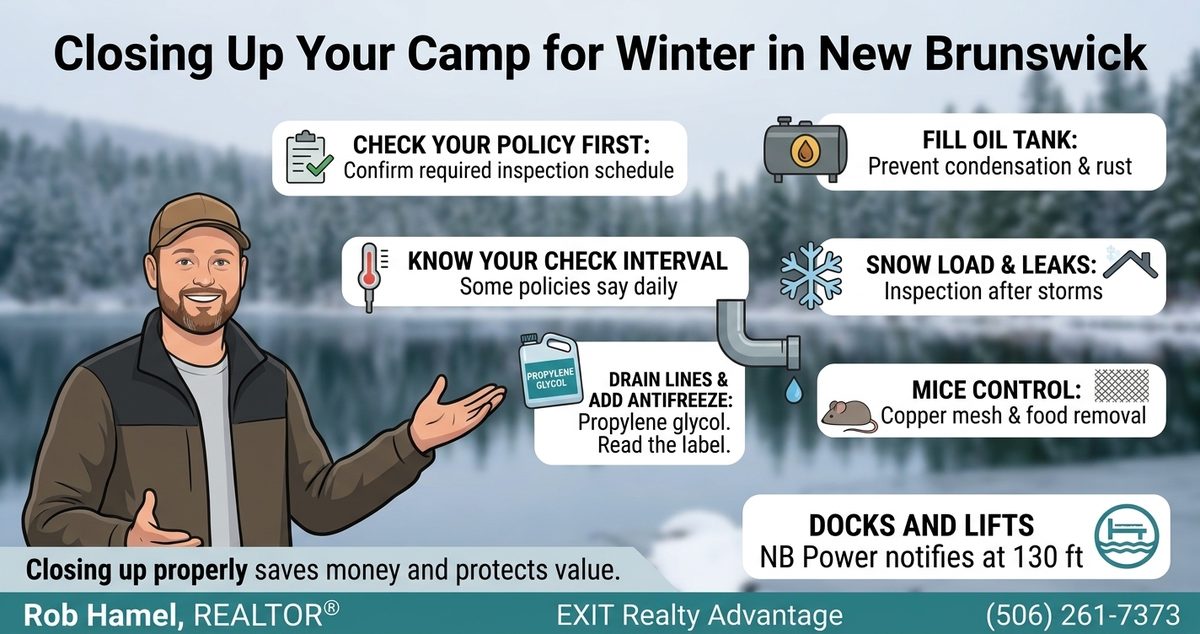
Two things cost people real money when they close a camp, and neither of them is the thing most checklists lead with.
The short version. Find out what your insurance policy requires of you before you decide how to close the place — the interval it gives you is probably much shorter than you think. And when you buy antifreeze, read the label rather than the colour.
The rest is a plumbing job and an afternoon. Worth doing properly, but it is not where the money goes.
The insurance condition people get wrong
Many Canadian home and seasonal policies carry a condition about what happens when a dwelling sits unoccupied during the heating season. The usual shape of it is that you either shut the water off and drain the system, or you keep the heat on and have a person physically go inside and confirm it on a set schedule.
Do not assume that schedule is generous. A lot of wordings say daily. Seventy-two hours to a few days is common. Some policies also require a separate periodic inspection during a long vacancy — that is a looser interval, and a different clause from the freezing one. People mix the two up and check monthly on a policy that wanted daily.
Two more things worth knowing, because camp owners routinely assume otherwise:
- A sensor usually does not satisfy the condition. Several carriers want a person to physically enter the building. A temperature alarm on your phone tells you it is 2°C in there. It does not turn the water off.
- A claim can be denied on a policy that is active and fully paid. The coverage is conditional on your end of the bargain, and the burst pipe is exactly when anyone checks.
I am a REALTOR®, not an insurance broker, so take this as a prompt rather than advice: call your broker, ask what your policy requires of you between now and spring, and ask them to put the answer in writing. Ten-minute phone call, and it is the single highest-value thing on this page.
While we are on terminology — “winterized”
To a plumber or an insurance adjuster, winterized means shut down: water off, lines drained, antifreeze in the traps, building closed for the season. That is the standard meaning and the one I would assume.
But I have also seen it used around here to mean nearly the opposite — insulated, heated, plumbed to stay in service, usable in February. What most people mean when they say four-season.
Same word, two readings, and a buyer can picture Christmas at the lake while the seller means they drain it every October like their father did. I would not assume either version.
If you are buying, ask it in plain terms: is this place usable in winter, and if so, what is the heat source and is the water line below frost? If you are selling, write four-season or write seasonal. Do not write winterized and leave it to chance.
The water system, and the parts people get wrong
Assuming you are draining rather than heating:
Kill power or fuel to the hot water tank before you drain it. An electric element fired in an empty tank can be destroyed in under a minute. Breaker first, then drain.
Shut off at the source — wellhead, pump, or main valve — then open every tap in the building, hot and cold, and leave them open. Open the lowest drain point you have and let gravity do the work.
Drain the pressure tank. It holds several gallons after the lines look empty and it is a common one to forget.
Toilets: tank and bowl both. Flush, then sponge the tank dry. The bowl trap takes antifreeze.
Read the label, not the colour. You want antifreeze that says propylene glycol and safe for potable water systems. That is the non-toxic stuff, made to sit in a drinking-water line. Some RV antifreeze is ethanol-based, some of that is explicitly labelled non-potable, and it is all the same pink — so “the pink stuff” tells you nothing. Automotive antifreeze is a different product again: almost all of it is ethylene glycol, which is poisonous, and it has no business near a drinking-water line, a septic field or a lake.
Pour it into every P-trap — sinks, tub, shower, floor drain, washer standpipe — and flush the system through properly in spring before anyone drinks from it. Even the potable-rated stuff is meant to be flushed out, not diluted and forgotten.
Do not forget the appliances. Washing machine and dishwasher both hold water in the pump and the fill lines.
If you have a compressor, blowing the lines out before you add antifreeze is belt and braces. It is the difference between mostly empty and actually empty, and mostly empty is what splits a fitting.
Fill the oil tank, do not run it down
The instinct is to burn the tank low so nothing is sitting there all winter. It is backwards. Empty space in a tank is air, air carries moisture, and every warm-then-cold cycle condenses some of it out. Water is heavier than oil, so it collects on the bottom of the tank and quietly rusts it from the inside while the outside still looks fine.
Fill it before you close up. Less air, less condensation.
While you are out there, look at the vent pipe and the fill cap on an outdoor tank. A missing cap or an unshielded vent is a direct route for water, and it is a five-dollar fix that people walk past for years.
Tanks and insurance in New Brunswick are their own subject, and if yours is getting on in years it is worth reading what the province requires and what your insurer will actually accept before next season.
Heat on or heat off — pick one and commit
The failures I hear about are almost always the half-measure: heat left on low, nobody checking, and a power cut in an ice storm that nobody notices for three weeks.
If the heat stays on, you need two things you may not have: reliable power, and a person. Not a camera — a person who will go and look, on whatever schedule your policy actually names.
If the heat goes off, drain it properly and stop worrying about it.
What does not work is heat on, no eyes, and hope.
The roof, and what you will not find until April
An unheated building does not melt its own snow. That is good news for ice dams — no meltwater running down to refreeze at the eaves — and worse news for load. Building codes reflect it directly: an unheated building is designed for roughly twenty per cent more snow load than a heated one, because the snow sits there.
It also means anything that lets go in January sits there until you open the place up. A leak that starts in a February thaw and runs until May is not a leak by the time you find it. It is a mould remediation, and it is the reason camps show up with that smell.
If you can get someone to walk the property after a heavy storm, do. If you cannot, at least go in knowing that the first spring visit is an inspection, not a beer on the deck — look at ceilings, look at corners, and look under the building. Water in a crawlspace behaves the same way it does in a basement in town, just with nobody around to notice.
Mice
Every gap you can see a mouse can use, and several you cannot. Copper or stainless mesh packed into penetrations first, then foam over it. Ordinary steel wool is fine for dry gaps inside, but it rusts away outdoors and in a damp crawlspace, which is exactly where you need it to last. Foam on its own gets chewed straight through.
Take every scrap of food out, including the things that do not feel like food — soap, candles, birdseed, dog kibble in the porch. And leave interior doors open so whatever does get in does not spend the winter trapped in one room.
If you are on the Mactaquac headpond
Worth knowing for anyone with a dock, a boathouse or a water intake. NB Power runs the headpond at a normal operating level between 128 and 133 feet, and levels move around inside that range during maintenance and dry spells.
The number to watch is 130 feet — that is the point at which NB Power notifies property owners to take precautions, and you can ask their corporate communications people to put you on the email list for expected drops below it. Real-time levels are published at nbpower.com/mtq.
The practical version: get docks and lifts out while you can still see where the bottom is, and do not leave a boat moored on a pond that may be dropping. Boats have been damaged here when the level came down without much notice.
What this has to do with what the place is worth
A camp that has been closed properly every year shows it, and one that has not shows that too. Soft floor by the back door, stained ceiling in the bedroom, rust weeping from a tank seam — a buyer’s inspector reads all three the same way, as a property that was looked after when it was convenient.
If you are thinking about selling the camp next spring, the useful conversation is this fall, not in May. What you do in the next three weeks is most of what a buyer will see in June, and the listings that do well on the water here are the ones where the owner had a plan before freeze-up rather than a scramble after the ice went out.
Buying instead? What to check before you buy rural in New Brunswick covers wells, septic, radon, financing and the rest. It is written for year-round rural property, and almost all of it applies double to a camp.
Rob Hamel is a REALTOR® with EXIT Realty Advantage in Fredericton and has a residential construction background. (506) 261-7373.
