
 Facebook
 X
X
 Pinterest
 Copy Link
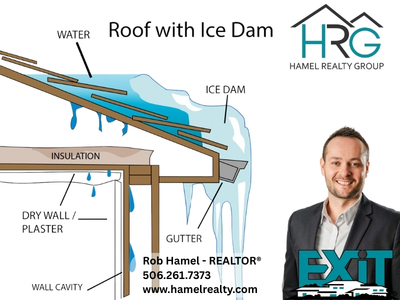
Most advice about ice dams is about ice. Roof rakes, heat cables, chipping away at the eave with a hammer and hoping for the best.
That advice treats the symptom. An ice dam is not a roofing problem and it is not a weather problem — plenty of Fredericton houses on the same street, under the same snow, do not get them. It is a heat-loss problem. Your house is warming the underside of its own roof, and the ice at the eave is the receipt.
Spend twenty minutes understanding that and you can usually fix it once, in the fall, instead of fighting it every February.
What an ice dam actually is
Snow on a cold roof stays put. Snow on a roof that is being warmed from below melts at the surface of the sheathing, and that meltwater runs down under the snow pack until it reaches the part of the roof that overhangs the wall — the eave, which has no heated space beneath it and sits at outdoor temperature.
There it refreezes. Natural Resources Canada describes the result as “large masses of ice that collect typically on the lower edge of a roof and in the gutters.”
Now you have a dam. The next round of meltwater backs up behind it, and standing water on a shingle roof is a problem shingles were never designed for. Shingles shed water running downhill. They do not seal against water sitting still and working sideways under the laps. That is how it gets into the sheathing, down the wall cavity, and onto a ceiling.
One detail most people miss: deep snow makes it worse, not better. Snow is an insulator. A thick blanket of it holds attic heat against the sheathing instead of letting it escape, so the melting runs faster under heavy snow than under light. NRCan also notes that dark south-facing siding heated by sun can push warm air up into the eave and cause damming on that side alone, which is why you sometimes see it on one face of a roof and nowhere else.
The thing that surprises people: insulation alone is not the fix
Here is the part that runs against intuition, and it comes straight from NRCan: uninsulated attics usually do not get ice dams. They leak so much heat so evenly that the whole roof stays warm and the snow is gone before it can refreeze at the eave.
A properly sealed and insulated attic also does not get ice dams, because the roof stays cold.
The houses that get them are in the middle — some insulation, but air leaking past it. That describes an enormous number of Fredericton homes built between the 1950s and the 1990s, and quite a few newer ones where somebody blew in more insulation without sealing anything first.
That matters because of what it tells you to do, and in what order.
The order of operations, and almost everyone gets it backwards
NRCan is unambiguous about the sequence, and it is not the sequence most homeowners follow.
1. Air seal first. This is the one that does the work. Warm indoor air rises and finds every hole in the ceiling plane: plumbing stacks, wiring penetrations, light fixtures, bath fan ducting, the attic hatch, the gap where an interior wall meets the ceiling, the chimney chase. NRCan’s wording is blunt — “the importance of air sealing cannot be overstated,” and “the best prevention for ice damming is to seal all attic air leaks and insulate thoroughly.”
2. Then insulate. The federal target for an attic upgrade was RSI 8.81, which is R-50. If you are standing in your attic looking at six inches of settled batt, you are somewhere around R-19 and you have a long way to go.
3. Then check the ventilation is not blocked. For a peaked roof with an accessible attic the standard is a 1:300 ratio — one square foot of unobstructed vent for every 300 square feet of insulated ceiling — and NRCan recommends roughly half of it at the soffits and half at ridge or gable vents. The ratio has to increase if the vents are screened or baffled, because screening cuts the clear area.
Note the order. Ventilation is third, and NRCan is explicit that it is not a substitute for the first two: vents “will not prevent condensation and will not solve the problems created by air leakage.” Adding roof vents to a leaky ceiling is a very common, very expensive way to change nothing.
Five things not to do
Do not chip the ice off. You are swinging a tool at the most vulnerable part of the roof, in the cold, when shingles are brittle. People put holes in roofs doing this every winter.
Do not block the soffits with insulation. Leave 38 to 50 mm — an inch and a half to two inches — between the top of the insulation and the underside of the sheathing at the eave, with baffles to hold it open. Blown-in insulation pushed tight into the eave is one of the most common things I find in an attic, and it chokes off exactly the ventilation the roof needs.
Do not put an electric exhaust fan in the attic. NRCan warns these “can draw more air than can be supplied through the soffit vents,” which pulls heated house air up into the attic. You have made the problem worse and paid to do it.
Do not bury standard recessed lights. They are hard to seal and a fire risk if covered. Keep the clearance — a minimum of half an inch, preferably six — or replace them with sealed IC-rated fixtures while the attic is open.
Do not compress the insulation. Batts squashed into a joist bay do not deliver their rated value. Fit them snugly and run the second layer perpendicular across the joists.
Heat cables: a real disagreement worth knowing about
Two credible sources do not agree here, and it is worth saying so rather than pretending there is a consensus.
The Insurance Bureau of Canada lists installing heat cables among its prevention steps. NRCan groups electric heating cables with gutter removal and ice chipping as quick fixes, and says “the preferred solution for most houses is to keep house heat out of the attic by air sealing and insulating.”
Both positions make sense from where each is standing. A cable keeps a drainage channel open and can stop water backing up tonight, which is a genuine thing to want when the ceiling is already staining. It also runs on electricity all winter, does nothing about the heat loss causing the melt, and will still be needed next year and the year after.
My read: a heat cable is a tourniquet. It is a reasonable thing to install on a problem roof while you plan the real fix, and a poor thing to install instead of the real fix.
What insurance actually covers, and the word that matters
This is the part I would want to know as a homeowner, and it is not complicated once you see the distinction the industry draws.
The Insurance Bureau of Canada says standard homeowner policies “commonly cover sudden and accidental water damage caused by ice dams.” But — and this is the sentence to read twice — “ongoing or repeated damage is considered a long-term maintenance issue and may not be covered.”
So the first time water comes through a ceiling, you are likely in reasonable shape. The third winter in a row, with the same stain spreading on the same ceiling, you are arguing that a known recurring condition is sudden and accidental. That is a difficult argument.
IBC also notes plainly that “basic insurance policies might not cover damage from ice dams” at all, and that coverage varies — which means the only way to know what you have is to read your own policy or ask your broker about water damage endorsements. I am a REALTOR®, not an insurance broker, and your policy is the only document that answers this for your house.
The practical version: ice dams are one of the few home problems where fixing the cause also protects your claim.
What this means if you are buying
Ice staining at the eaves, or a repaired-looking patch of ceiling under an exterior wall, is worth asking about. So is a roof with a brand-new covering and an attic that has never been touched — a new roof over an unsealed ceiling buys you a new roof and the same ice dams.
In an attic I am looking at whether the insulation is deep and even or thin and drifted, whether the soffits are open or stuffed, whether there is a vapour barrier and whether anything has been sealed around the penetrations, and whether the sheathing shows dark staining or rusted nail tips — both signs that warm moist air has been getting up there for years.
None of that kills a deal. It changes what you offer, what you condition on, and what you budget for in the first two years. The same logic applies to water in a basement, and it is the kind of thing worth understanding before you write, not after. If you are early in the process, start with buying a home in Fredericton.
Money, and one program that has closed
The federal Canada Greener Homes Grant is closed — the final document deadline was 31 December 2025. If you find a blog post telling you to apply, it is out of date.
What is still running in this province is the Total Home Energy Savings Program, delivered by NB Power with federal and provincial funding. It covers insulation and air sealing, and it starts with a Home Energy Evaluation by a certified energy advisor rather than with a contractor’s quote. Homeowners get nine months from the evaluation to complete the upgrades. The number is 1-800-663-6272.
I have no financial interest in any of this. It is just the sensible first call if you are about to spend real money on an attic.
The honest summary
If your Fredericton roof grows ice at the eaves every winter, the ice is telling you something specific: warm air is getting into your attic. Seal it, insulate it to R-50, make sure the soffits can breathe, and the ice usually stops being an annual event.
Do it in October, in a dry attic, in daylight. Doing it in February means doing it badly.
The pre-winter attic and roof items are on my seasonal checklist, along with the rest of what a Fredericton house needs before the snow. Download the printable version here.
Sources
- Natural Resources Canada — Keeping the Heat In, Section 5: Roofs and attics
- Natural Resources Canada — Canada Greener Homes Initiative, eligible retrofits and grant amounts (programme closed 31 December 2025)
- Insurance Bureau of Canada — Stay protected: Understanding and helping prevent ice dams
- NB Power / Save Energy NB — Total Home Energy Savings Program
I am a REALTOR® with a construction background, not a roofer, an insulation contractor, a building scientist or an insurance broker. This is general information about how these systems behave, not advice about your specific house or your specific policy.
