
 Facebook
 X
X
 Pinterest
 Copy Link
Fredericton Had Its Busiest September for New Listings in a Decade. Now What?
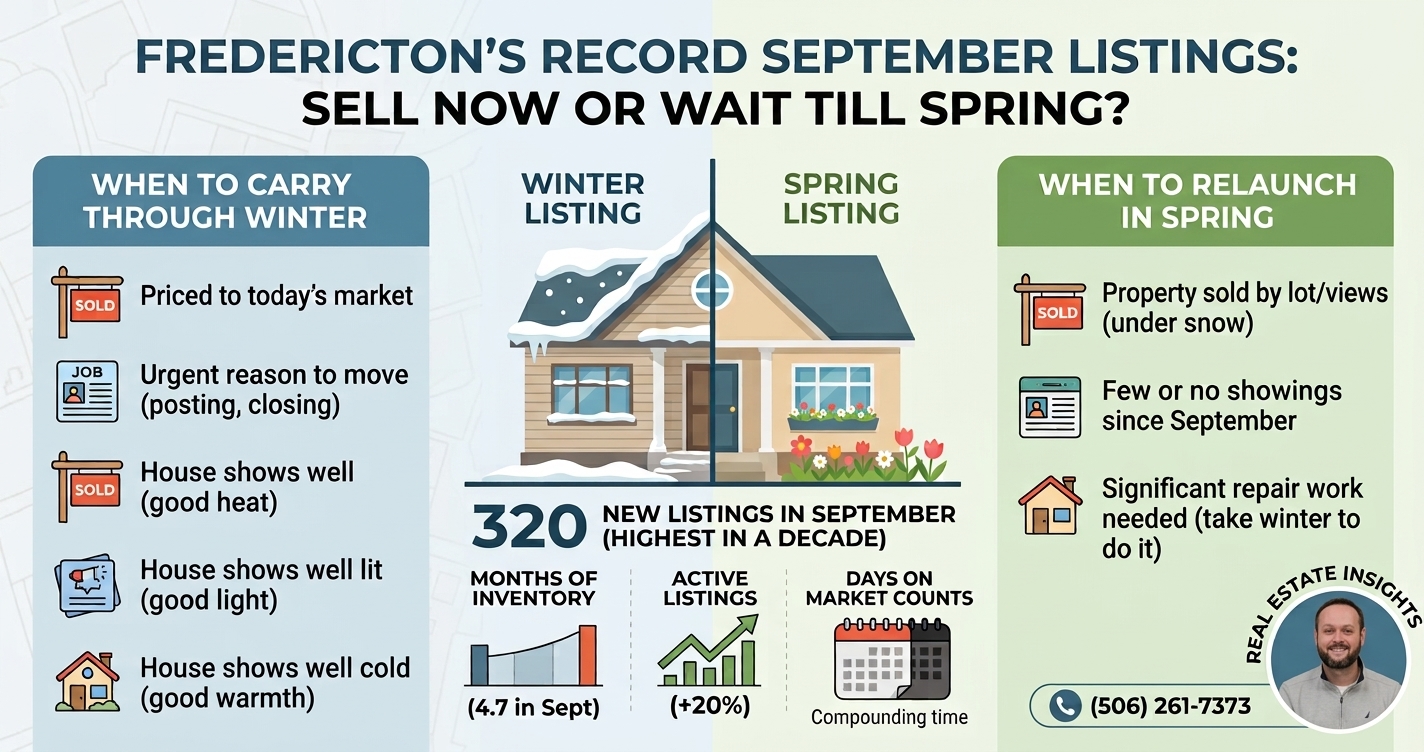
In September, 320 homes came onto the market in the Fredericton region. That is the highest new-listing count for any September in the board’s ten-year series.
Those listings do not evaporate when the weather turns. Most of them are still out there, and a good number of the sellers behind them are now working through the same question: do I carry this through the winter, or do I come off and try again in the spring?
There is no single right answer. But there is a wrong way to decide it, which is by the calendar alone.
What the September numbers actually say
The headline figures are on the market update page, which I rebuild every month. The three that matter for this decision:
Inventory moved from 3.4 months in August to 4.7 months in September. That is the clearest signal in the whole release. A year ago it was 3.5. Buyers have choice again in a way they have not had for several years.
There were 747 active listings at month end, about 20% more than a year earlier. More competition for every showing.
Sale-to-list has drifted from 99.0% to 98.4% over the year. Small, but it is moving in one direction, and it tells you buyers are negotiating rather than simply accepting.
What has not happened is a price drop. The MLS® HPI benchmark was $364,400, up 4.4% on the year. Supply loosened. Prices did not fall.
The question is not “is winter a bad time to sell”
I get asked that every October and it is the wrong frame.
Yes, fewer people shop in January than in June. But fewer people list in January too, and the buyers who are out in a Fredericton February — boots on, scraping the windshield at 7am to make a showing — are not browsing. Nobody tours a house in that weather for entertainment. The traffic drops; the seriousness of the traffic goes up.
The better question is narrower: what is it costing me to keep this particular listing on the market?
Days on market are the thing that compounds
A listing that went up in mid-September and is still active in January is carrying four months of days on market, and that number is the first thing a buyer’s agent looks at after the price.
It does not matter that December was quiet. It does not matter that the house is lovely. A long days-on-market number reads as something is wrong with this one, and the buyer starts from the assumption that there is a deal to be had. Median days on market across the region is 28. A listing at 120 is being read against that.
That is the real cost of carrying, and it is why “we’ll just leave it up and see” is the most expensive decision available. It is not neutral. It is accumulating.
When carrying through the winter is the right call
You are priced to today, not to last spring. If your price reflects 4.7 months of inventory rather than the market you watched your neighbour sell into eighteen months ago, winter is survivable. If it does not, winter will not fix it — it will just add days.
You need to move for a reason that has a date on it. A posting, a job, a closing on something you have already bought. Waiting has its own cost in that situation, and it usually exceeds the seasonal one.
The house shows well cold. Good heat, warm light, a dry basement, a driveway that gets cleared. Some homes are genuinely better in winter than in a muddy April.
When coming off and relaunching is the right call
You have had the home listed since September with few or no showings. That is not a seasonal problem. That is a pricing or presentation problem that a spring launch will not solve on its own, and relaunching without changing anything just restarts the clock on the same result.
The property is sold by its lot. Acreage, waterfront, a garden, a view, anything rural. You are asking a buyer to imagine the best version of a property under a metre of snow. That is a harder sale than it needs to be, and it is one of the few cases where I will genuinely suggest waiting.
The work you need to do takes months. If the honest answer is that the kitchen or the roof or the grading has to be dealt with before this house sells well, take the winter and do it. That is not retreating, that is preparing.
What winter showings hide, and what they reveal
I came into real estate from residential construction, so this is the part I actually enjoy.
Winter hides the things buyers normally judge a house on: the landscaping, the roof, the grading, the state of the driveway. If you are buying in February you are going back in April, or you are relying on someone who knows what to look for under the snow.
But winter also reveals things a June showing never will. Cold drafts at the outlets and baseboards. A furnace or heat pump working hard in real conditions. Ice at the eaves, which tells you about attic insulation and ventilation long before it tells you about the roof. Condensation on the windows. Whether the basement stays dry through a thaw.
Those are the things that cost money after you own a house, and I would rather see them in February than guess at them in July. If you want the detail, I keep a page on the problems that turn up most often in Fredericton homes.
So — sell now or wait?
Decide it on your price, your property and your reason for moving. Not on the month.
If your home is priced to the market that exists today, shows well in cold weather, and you have a reason to move, list it and let the quiet buyers come. If it has been sitting since September without showings, use the winter to fix whatever is causing that, and come back in the spring with a different listing rather than the same one.
If you are not sure which of those describes your situation, that is a conversation, not a calculation. What your home is actually worth today is the place to start, and the selling guide covers the costs and the process end to end. If pricing is the sticking point, how to price a home in Fredericton goes through it properly.
I answer my own phone — (506) 261-7373.
Closing Up Your Camp for Winter in New Brunswick
Two things cost people real money when they close a camp, and neither of them is the thing most checklists lead with.
The short version. Find out what your insurance policy requires of you before you decide how to close the place — the interval it gives you is probably much shorter than you think. And when you buy antifreeze, read the label rather than the colour.
The rest is a plumbing job and an afternoon. Worth doing properly, but it is not where the money goes.
The insurance condition people get wrong
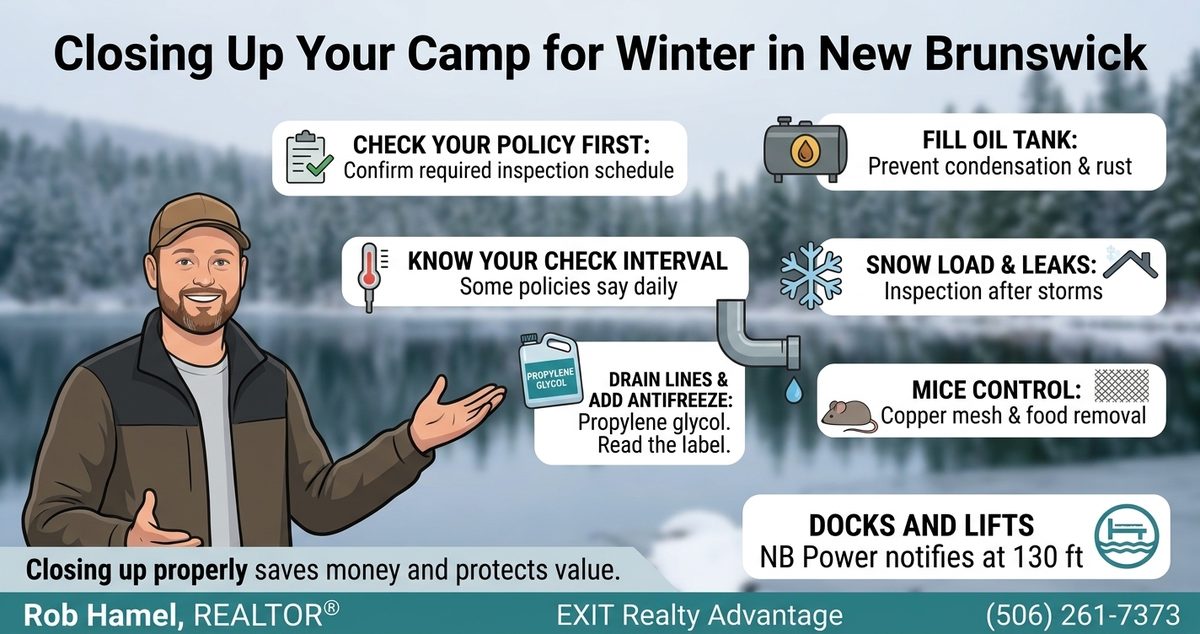
Many Canadian home and seasonal policies carry a condition about what happens when a dwelling sits unoccupied during the heating season. The usual shape of it is that you either shut the water off and drain the system, or you keep the heat on and have a person physically go inside and confirm it on a set schedule.
Do not assume that schedule is generous. A lot of wordings say daily. Seventy-two hours to a few days is common. Some policies also require a separate periodic inspection during a long vacancy — that is a looser interval, and a different clause from the freezing one. People mix the two up and check monthly on a policy that wanted daily.
Two more things worth knowing, because camp owners routinely assume otherwise:
- A sensor usually does not satisfy the condition. Several carriers want a person to physically enter the building. A temperature alarm on your phone tells you it is 2°C in there. It does not turn the water off.
- A claim can be denied on a policy that is active and fully paid. The coverage is conditional on your end of the bargain, and the burst pipe is exactly when anyone checks.
I am a REALTOR®, not an insurance broker, so take this as a prompt rather than advice: call your broker, ask what your policy requires of you between now and spring, and ask them to put the answer in writing. Ten-minute phone call, and it is the single highest-value thing on this page.
While we are on terminology — “winterized”
To a plumber or an insurance adjuster, winterized means shut down: water off, lines drained, antifreeze in the traps, building closed for the season. That is the standard meaning and the one I would assume.
But I have also seen it used around here to mean nearly the opposite — insulated, heated, plumbed to stay in service, usable in February. What most people mean when they say four-season.
Same word, two readings, and a buyer can picture Christmas at the lake while the seller means they drain it every October like their father did. I would not assume either version.
If you are buying, ask it in plain terms: is this place usable in winter, and if so, what is the heat source and is the water line below frost? If you are selling, write four-season or write seasonal. Do not write winterized and leave it to chance.
The water system, and the parts people get wrong
Assuming you are draining rather than heating:
Kill power or fuel to the hot water tank before you drain it. An electric element fired in an empty tank can be destroyed in under a minute. Breaker first, then drain.
Shut off at the source — wellhead, pump, or main valve — then open every tap in the building, hot and cold, and leave them open. Open the lowest drain point you have and let gravity do the work.
Drain the pressure tank. It holds several gallons after the lines look empty and it is a common one to forget.
Toilets: tank and bowl both. Flush, then sponge the tank dry. The bowl trap takes antifreeze.
Read the label, not the colour. You want antifreeze that says propylene glycol and safe for potable water systems. That is the non-toxic stuff, made to sit in a drinking-water line. Some RV antifreeze is ethanol-based, some of that is explicitly labelled non-potable, and it is all the same pink — so “the pink stuff” tells you nothing. Automotive antifreeze is a different product again: almost all of it is ethylene glycol, which is poisonous, and it has no business near a drinking-water line, a septic field or a lake.
Pour it into every P-trap — sinks, tub, shower, floor drain, washer standpipe — and flush the system through properly in spring before anyone drinks from it. Even the potable-rated stuff is meant to be flushed out, not diluted and forgotten.
Do not forget the appliances. Washing machine and dishwasher both hold water in the pump and the fill lines.
If you have a compressor, blowing the lines out before you add antifreeze is belt and braces. It is the difference between mostly empty and actually empty, and mostly empty is what splits a fitting.
Fill the oil tank, do not run it down
The instinct is to burn the tank low so nothing is sitting there all winter. It is backwards. Empty space in a tank is air, air carries moisture, and every warm-then-cold cycle condenses some of it out. Water is heavier than oil, so it collects on the bottom of the tank and quietly rusts it from the inside while the outside still looks fine.
Fill it before you close up. Less air, less condensation.
While you are out there, look at the vent pipe and the fill cap on an outdoor tank. A missing cap or an unshielded vent is a direct route for water, and it is a five-dollar fix that people walk past for years.
Tanks and insurance in New Brunswick are their own subject, and if yours is getting on in years it is worth reading what the province requires and what your insurer will actually accept before next season.
Heat on or heat off — pick one and commit
The failures I hear about are almost always the half-measure: heat left on low, nobody checking, and a power cut in an ice storm that nobody notices for three weeks.
If the heat stays on, you need two things you may not have: reliable power, and a person. Not a camera — a person who will go and look, on whatever schedule your policy actually names.
If the heat goes off, drain it properly and stop worrying about it.
What does not work is heat on, no eyes, and hope.
The roof, and what you will not find until April
An unheated building does not melt its own snow. That is good news for ice dams — no meltwater running down to refreeze at the eaves — and worse news for load. Building codes reflect it directly: an unheated building is designed for roughly twenty per cent more snow load than a heated one, because the snow sits there.
It also means anything that lets go in January sits there until you open the place up. A leak that starts in a February thaw and runs until May is not a leak by the time you find it. It is a mould remediation, and it is the reason camps show up with that smell.
If you can get someone to walk the property after a heavy storm, do. If you cannot, at least go in knowing that the first spring visit is an inspection, not a beer on the deck — look at ceilings, look at corners, and look under the building. Water in a crawlspace behaves the same way it does in a basement in town, just with nobody around to notice.
Mice
Every gap you can see a mouse can use, and several you cannot. Copper or stainless mesh packed into penetrations first, then foam over it. Ordinary steel wool is fine for dry gaps inside, but it rusts away outdoors and in a damp crawlspace, which is exactly where you need it to last. Foam on its own gets chewed straight through.
Take every scrap of food out, including the things that do not feel like food — soap, candles, birdseed, dog kibble in the porch. And leave interior doors open so whatever does get in does not spend the winter trapped in one room.
If you are on the Mactaquac headpond
Worth knowing for anyone with a dock, a boathouse or a water intake. NB Power runs the headpond at a normal operating level between 128 and 133 feet, and levels move around inside that range during maintenance and dry spells.
The number to watch is 130 feet — that is the point at which NB Power notifies property owners to take precautions, and you can ask their corporate communications people to put you on the email list for expected drops below it. Real-time levels are published at nbpower.com/mtq.
The practical version: get docks and lifts out while you can still see where the bottom is, and do not leave a boat moored on a pond that may be dropping. Boats have been damaged here when the level came down without much notice.
What this has to do with what the place is worth
A camp that has been closed properly every year shows it, and one that has not shows that too. Soft floor by the back door, stained ceiling in the bedroom, rust weeping from a tank seam — a buyer’s inspector reads all three the same way, as a property that was looked after when it was convenient.
If you are thinking about selling the camp next spring, the useful conversation is this fall, not in May. What you do in the next three weeks is most of what a buyer will see in June, and the listings that do well on the water here are the ones where the owner had a plan before freeze-up rather than a scramble after the ice went out.
Buying instead? What to check before you buy rural in New Brunswick covers wells, septic, radon, financing and the rest. It is written for year-round rural property, and almost all of it applies double to a camp.
Rob Hamel is a REALTOR® with EXIT Realty Advantage in Fredericton and has a residential construction background. (506) 261-7373.
Fredericton Home Preparation Before Vacation Checklist

If you’re travelling this March Break, proper Fredericton home preparation before vacation is essential. Even a short trip can lead to costly damage if your home isn’t protected from freezing temperatures, water leaks, or security risks.
Here’s a simple checklist to prepare your Fredericton home before leaving town.
1️⃣ Keep the Heat On
Even if you’re heading somewhere warm, never turn your heat off completely. March temperatures in Fredericton can still drop below freezing. Set your thermostat to at least 15°C to prevent frozen pipes and protect flooring, drywall, and cabinetry from temperature swings.
This is one of the most important steps in winter home preparation before vacation.
Follow NB Power’s winter heating recommendations.
2️⃣ Shut Off the Main Water Valve
Water damage is one of the most common and expensive home insurance claims in Canada. Before you leave, turn off your main water supply. Then run a tap briefly to relieve pressure in the system.
Taking this step during your Fredericton home preparation before vacation can prevent thousands of dollars in repairs.
Water damage prevention tips from the Insurance Bureau of Canada.
3️⃣ Arrange Snow Removal
March weather in New Brunswick is unpredictable. An uncleared driveway or walkway signals that no one is home and can also create safety issues.
Ask a neighbour, friend, or snow removal service to clear your property if needed while you’re away.
Check the Fredericton weather forecast before travelling.
Review Fredericton snow clearing guidelines.
4️⃣ Use Light Timers
Light timers make your home appear occupied. Set a few lamps and possibly an exterior light to turn on in the evening and off at night.
Avoid leaving lights on continuously. Natural patterns are more effective.
5️⃣ Pause Deliveries
Mail and packages piling up are clear signs a home is vacant. Place a temporary hold with Canada Post and pause any subscription deliveries before leaving.
This small step adds an extra layer of protection.
Place a temporary mail hold with Canada Post before you leave.
6️⃣ Clean Out the Fridge
Before travelling, dispose of perishables such as milk, produce, and leftovers. Spoiled food can create strong odours and make returning home unpleasant.
It only takes a few minutes and saves you from an unnecessary surprise.
7️⃣ Leave an Emergency Contact
Finally, provide a trusted neighbour with your travel dates and contact information. If you feel comfortable, leave a spare key.
Having someone nearby who can quickly check on your property offers real peace of mind.
Proper Fredericton home preparation before vacation takes less than 30 minutes but can prevent major stress and unexpected costs.
If you ever have questions about protecting your investment — or if you’re considering buying or selling in Fredericton — I’m always happy to help.
Safe travels! ✈️
Ice Dams on Fredericton Roofs: What Causes Them and How to Stop Them

Most advice about ice dams is about ice. Roof rakes, heat cables, chipping away at the eave with a hammer and hoping for the best.
That advice treats the symptom. An ice dam is not a roofing problem and it is not a weather problem — plenty of Fredericton houses on the same street, under the same snow, do not get them. It is a heat-loss problem. Your house is warming the underside of its own roof, and the ice at the eave is the receipt.
Spend twenty minutes understanding that and you can usually fix it once, in the fall, instead of fighting it every February.
What an ice dam actually is
Snow on a cold roof stays put. Snow on a roof that is being warmed from below melts at the surface of the sheathing, and that meltwater runs down under the snow pack until it reaches the part of the roof that overhangs the wall — the eave, which has no heated space beneath it and sits at outdoor temperature.
There it refreezes. Natural Resources Canada describes the result as “large masses of ice that collect typically on the lower edge of a roof and in the gutters.”
Now you have a dam. The next round of meltwater backs up behind it, and standing water on a shingle roof is a problem shingles were never designed for. Shingles shed water running downhill. They do not seal against water sitting still and working sideways under the laps. That is how it gets into the sheathing, down the wall cavity, and onto a ceiling.
One detail most people miss: deep snow makes it worse, not better. Snow is an insulator. A thick blanket of it holds attic heat against the sheathing instead of letting it escape, so the melting runs faster under heavy snow than under light. NRCan also notes that dark south-facing siding heated by sun can push warm air up into the eave and cause damming on that side alone, which is why you sometimes see it on one face of a roof and nowhere else.
The thing that surprises people: insulation alone is not the fix
Here is the part that runs against intuition, and it comes straight from NRCan: uninsulated attics usually do not get ice dams. They leak so much heat so evenly that the whole roof stays warm and the snow is gone before it can refreeze at the eave.
A properly sealed and insulated attic also does not get ice dams, because the roof stays cold.
The houses that get them are in the middle — some insulation, but air leaking past it. That describes an enormous number of Fredericton homes built between the 1950s and the 1990s, and quite a few newer ones where somebody blew in more insulation without sealing anything first.
That matters because of what it tells you to do, and in what order.
The order of operations, and almost everyone gets it backwards
NRCan is unambiguous about the sequence, and it is not the sequence most homeowners follow.
1. Air seal first. This is the one that does the work. Warm indoor air rises and finds every hole in the ceiling plane: plumbing stacks, wiring penetrations, light fixtures, bath fan ducting, the attic hatch, the gap where an interior wall meets the ceiling, the chimney chase. NRCan’s wording is blunt — “the importance of air sealing cannot be overstated,” and “the best prevention for ice damming is to seal all attic air leaks and insulate thoroughly.”
2. Then insulate. The federal target for an attic upgrade was RSI 8.81, which is R-50. If you are standing in your attic looking at six inches of settled batt, you are somewhere around R-19 and you have a long way to go.
3. Then check the ventilation is not blocked. For a peaked roof with an accessible attic the standard is a 1:300 ratio — one square foot of unobstructed vent for every 300 square feet of insulated ceiling — and NRCan recommends roughly half of it at the soffits and half at ridge or gable vents. The ratio has to increase if the vents are screened or baffled, because screening cuts the clear area.
Note the order. Ventilation is third, and NRCan is explicit that it is not a substitute for the first two: vents “will not prevent condensation and will not solve the problems created by air leakage.” Adding roof vents to a leaky ceiling is a very common, very expensive way to change nothing.
Five things not to do
Do not chip the ice off. You are swinging a tool at the most vulnerable part of the roof, in the cold, when shingles are brittle. People put holes in roofs doing this every winter.
Do not block the soffits with insulation. Leave 38 to 50 mm — an inch and a half to two inches — between the top of the insulation and the underside of the sheathing at the eave, with baffles to hold it open. Blown-in insulation pushed tight into the eave is one of the most common things I find in an attic, and it chokes off exactly the ventilation the roof needs.
Do not put an electric exhaust fan in the attic. NRCan warns these “can draw more air than can be supplied through the soffit vents,” which pulls heated house air up into the attic. You have made the problem worse and paid to do it.
Do not bury standard recessed lights. They are hard to seal and a fire risk if covered. Keep the clearance — a minimum of half an inch, preferably six — or replace them with sealed IC-rated fixtures while the attic is open.
Do not compress the insulation. Batts squashed into a joist bay do not deliver their rated value. Fit them snugly and run the second layer perpendicular across the joists.
Heat cables: a real disagreement worth knowing about
Two credible sources do not agree here, and it is worth saying so rather than pretending there is a consensus.
The Insurance Bureau of Canada lists installing heat cables among its prevention steps. NRCan groups electric heating cables with gutter removal and ice chipping as quick fixes, and says “the preferred solution for most houses is to keep house heat out of the attic by air sealing and insulating.”
Both positions make sense from where each is standing. A cable keeps a drainage channel open and can stop water backing up tonight, which is a genuine thing to want when the ceiling is already staining. It also runs on electricity all winter, does nothing about the heat loss causing the melt, and will still be needed next year and the year after.
My read: a heat cable is a tourniquet. It is a reasonable thing to install on a problem roof while you plan the real fix, and a poor thing to install instead of the real fix.
What insurance actually covers, and the word that matters
This is the part I would want to know as a homeowner, and it is not complicated once you see the distinction the industry draws.
The Insurance Bureau of Canada says standard homeowner policies “commonly cover sudden and accidental water damage caused by ice dams.” But — and this is the sentence to read twice — “ongoing or repeated damage is considered a long-term maintenance issue and may not be covered.”
So the first time water comes through a ceiling, you are likely in reasonable shape. The third winter in a row, with the same stain spreading on the same ceiling, you are arguing that a known recurring condition is sudden and accidental. That is a difficult argument.
IBC also notes plainly that “basic insurance policies might not cover damage from ice dams” at all, and that coverage varies — which means the only way to know what you have is to read your own policy or ask your broker about water damage endorsements. I am a REALTOR®, not an insurance broker, and your policy is the only document that answers this for your house.
The practical version: ice dams are one of the few home problems where fixing the cause also protects your claim.
What this means if you are buying
Ice staining at the eaves, or a repaired-looking patch of ceiling under an exterior wall, is worth asking about. So is a roof with a brand-new covering and an attic that has never been touched — a new roof over an unsealed ceiling buys you a new roof and the same ice dams.
In an attic I am looking at whether the insulation is deep and even or thin and drifted, whether the soffits are open or stuffed, whether there is a vapour barrier and whether anything has been sealed around the penetrations, and whether the sheathing shows dark staining or rusted nail tips — both signs that warm moist air has been getting up there for years.
None of that kills a deal. It changes what you offer, what you condition on, and what you budget for in the first two years. The same logic applies to water in a basement, and it is the kind of thing worth understanding before you write, not after. If you are early in the process, start with buying a home in Fredericton.
Money, and one program that has closed
The federal Canada Greener Homes Grant is closed — the final document deadline was 31 December 2025. If you find a blog post telling you to apply, it is out of date.
What is still running in this province is the Total Home Energy Savings Program, delivered by NB Power with federal and provincial funding. It covers insulation and air sealing, and it starts with a Home Energy Evaluation by a certified energy advisor rather than with a contractor’s quote. Homeowners get nine months from the evaluation to complete the upgrades. The number is 1-800-663-6272.
I have no financial interest in any of this. It is just the sensible first call if you are about to spend real money on an attic.
The honest summary
If your Fredericton roof grows ice at the eaves every winter, the ice is telling you something specific: warm air is getting into your attic. Seal it, insulate it to R-50, make sure the soffits can breathe, and the ice usually stops being an annual event.
Do it in October, in a dry attic, in daylight. Doing it in February means doing it badly.
The pre-winter attic and roof items are on my seasonal checklist, along with the rest of what a Fredericton house needs before the snow. Download the printable version here.
Sources
- Natural Resources Canada — Keeping the Heat In, Section 5: Roofs and attics
- Natural Resources Canada — Canada Greener Homes Initiative, eligible retrofits and grant amounts (programme closed 31 December 2025)
- Insurance Bureau of Canada — Stay protected: Understanding and helping prevent ice dams
- NB Power / Save Energy NB — Total Home Energy Savings Program
I am a REALTOR® with a construction background, not a roofer, an insulation contractor, a building scientist or an insurance broker. This is general information about how these systems behave, not advice about your specific house or your specific policy.
Why Work With a REALTOR®?
About this series. I wrote “The blog of a first time home buyer” in 2019 from the point of view of a first-time buyer I was working with, using their real experience and their real numbers. The voice is theirs; I am the REALTOR® who was on the other side of it. Reviewed August 2026. For what working with me costs and what you get for it, see selling a home in Fredericton, where the commission is published in full, or buying a home in Fredericton.
You’re ready to start looking at houses, you know a little about what you want, what’s next? In my opinion, it’s time for you to hire your REALTORⓇ! Your REALTORⓇ is going to be your investigator, your paperwork guru, your negotiator, your cool 3rd wheel (maybe), and your partner through this process. Well, they should be, if they’re good… I’m going to take you through what I think is important when choosing your REALTORⓇ.
Full disclosure, I am extremely biased, I work part-time for a REALTORⓇ so I’m obviously going to tell you to work with one. However, I also think that working in an office of 80+ REALTORSⓇ has given me a unique perspective on what you should consider when choosing one. Either way, take this article with a grain of salt..
Before we get into choosing a REALTORⓇ, let’s talk about the why. Here’s a few reasons:
- It’s FREE – You might think that nothing in life is free, but if you’re a first time home buyer, the services of your REALTORⓇ are 100% free to you, no strings, no cost, nada! A REALTORⓇ’s commission comes from the seller’s side of the deal, so you don’t need to pay for the service at all!
- Paperwork – Purchasing a home involves a lot of paperwork and a lot of legal-ese. Having someone on your side that can help explain the ins and outs of the process will give you so much peace of mind! There’s so much more than just making an offer, and having someone that’s been through it hundreds of times makes it so much smoother. Remember, the details of purchasing a home can differ in every area, so don’t rely solely on internet resources (but keep reading my blog, okay?).
- Negotiations – Negotiations when you’re buying a house isn’t quite as easy as HGTV makes it look, you have to base your offers and counters on tangible facts about the property, about the costs of fixing issues (your REALTORⓇ has all the contacts to get you those quotes), and about historical data of the area. Making informed offers can help you hugely if you’re ever in a multiple offer situation!
- It’s FREE – Did I mention this already? Seriously though, it’s free, there’s no reason not to.
There’s wayyyy more reasons to use one, but I do hope that I’ve sold you on the idea of a REALTORⓇ! They’re there to protect and help you and there’s no reason not to use one when you’re buying your first home. It’s free to you, they’ve got your back, and they will help you literally with every step of the purchase… provided you pick a good one.
I already put up a disclaimer, but once again, I work for the REALTORⓇ I hired to help me with my purchase, but, I would have hired him even if I had not been working for him. I mean, you’re reading this on his website, so what follows will probably be a little biased towards Rob. I believe that I still have some worthwhile advice on making a choice, but if you’re here for 100% unbiased advice, you should probably click away now. Don’t forget to come back next week though when I go through the Mortgage Pre-Approval process and lingo!
So… What did I look for in my REALTORⓇ?
Here’s some of the qualities I think are important. Make your own list, or have a chat with your partner and prioritize these qualities, along with yours, so you can make an informed decision. You might not find anyone that will fit every single quality you’re looking for, but knowing what’s important to you will still help you find your best fit! One extra piece of advice, don’t be afraid to interview a few REALTORSⓇ! You do not need to work with the first one you contact! So, with that said, here are the qualities that were most important to me:
- Experience – This one’s pretty easy. I wanted someone who has been through a lot of transactions. While there are some amazing REALTORSⓇ just getting started, the knowledge and confidence that comes from having been through hundreds of transactions gives me a lot of peace of mind, so it was at the top of my list!
- Availability – Also pretty straightforward, but I wanted to work with someone who actually had time for me. I didn’t want to be passed off to a specific “buyers agent”, I wanted my transaction to matter, and that within reason, my REALTORⓇ would be available to help me see homes, answer questions, and just pick up the dang phone! Finding experience and availability can be tricky, but it’s definitely possible!
- Professionalism – See the trend, none of my wants so far have been that crazy. The main thing here is that I wanted to still feel valued and respected even though I was looking for my first home. Have you ever felt judged in a store because you didn’t seem like you could afford their products? I’ve been ignored at a few car dealerships before just for my age or the old car I used to drive, and I didn’t want to feel that way when purchasing my first home. Even if you’re looking for a $50,000 mini-home, you still deserve just as much respect from your REALTORⓇ as if you were purchasing a $400,000 home.
- Renovation/Construction Knowledge – Here’s the first more unique want. I wanted someone with real-life construction background or at least significant renovation experience. Why? Well, if I purchased something that needed fixing up, I wanted some advice on what actual costs would be, as well as advice and guidance. If I purchase something recently built, I wanted the knowledge that the contractors actually did a good job of it. I hate surprise costs, part of the reason I was happy to rent for so long, so making sure I wasn’t going to have to tear anything down right after I signed on the dotted line was very important to me.
With those qualities in mind, I chose my REALTORⓇ, Rob Hamel. He’s got over 10 years of sales experience, a background in construction, he’s into tech like me, and he actually answers his phone. He also works around 1 metre away from me, which made it very convenient to get a hold of him, but I mentioned that already.
When you’re choosing your REALTORⓇ, remember, consider your options and don’t feel like you have to use the first person you talk to. You want a partner, someone who has your best interest in mind, and someone you get along with well. On the flip side, don’t forget they’re humans with lives and families, so try not to have unrealistic expectations. Most full time REALTORSⓇ that I know work 70+ hours a week, so do your best to show your respect to them throughout the process. Oh, and I promise Rob didn’t make me write that part!
Next week, let’s get the scoop or Mortgages! What are they, how do I pick, what does amortization mean? So many questions! I’ll have (at least some of) the answers!
Andy Tree is a professional Wedding Photographer, marketing expert, coffee lover, millennial, board game enthusiast, and overall nerd. Over the next weeks he’ll fill you in on every step of his search and first home purchase.
Send us a message on Facebook if you have any specific questions or if you’re ready to start your own search!
How to Work an Open House Like a Pro
About this series. I wrote “The blog of a first time home buyer” in 2019 from the point of view of a first-time buyer I was working with, using their real experience and their real numbers. The voice is theirs; I am the REALTOR® who was on the other side of it. Reviewed and still accurate as at August 2026 — see buying a home in Fredericton for the current process and costs, or first-time home buyers in Fredericton for today’s programmes.
Last week, I discussed the thought process of what went into the decision to start the search for our first home. We were ready, or at least ready enough, to start looking at houses, so it was time for our first round of open houses, yay!
Now, by the time we had actually gone to our first round of open houses, I was spending a little time every day or two to scope out all the new listings on realtor.ca (tip: sort listings by new to see what’s come up since your last visit). Realtor.ca has a handy ability to sort by open houses, so you can schedule a route for your day, which is important because most open houses are only on for 2 hours (most commonly Sunday 2 to 4 in my area), and I wanted to see as many as I could my first time out!
With a few favourites picked and a few fillers added for variety, we hopped into the car and were off to see our first houses: a few townhouses, a cute bungalow that was currently an Airbnb, a 2 story historic family home, and another large bungalow.
I learned a lot from the first 3 homes I looked at, mostly because they were 3 identical townhouses. There was $10,000 difference between the 3, one vacant, 2 lived in, different paint, light and kitchen, but all in the same “frame”. What a great way to quickly learn how much a good coat of paint can make a house look! It’s really easy to get caught up in the style of the current homeowner, good or bad, and that really can sway your opinion of the space. I think if you have the possibility of viewing a few similar units on your first open house tour, I’d say go for it, you’ll definitely learn a lot!
The next few homes brought up the discussion of how much I’m willing to fix myself. Now, I’m not afraid to get my hands a little dirty, but during the summer I typically work a 60-80 hour workweek, so the property would really have to be perfect for me to take on anything extra. Everyone has a comfort level of what you’re willing to work on, and what you want right from ownership, so be sure to have a good think or a discussion with your partner about what suits your needs, and use the experience you gain from the open houses to help inform that decision.
Another major difference I noticed from home to home were the REALTORSⓇ I met. Full disclosure once again, I do work for a REALTORⓇ, and two of the ones I met with are from the same office, so my experience was not completely typical, but I did meet four others that I had not met before. Some were very friendly, upfront, and ready to answer any questions I had. Some made it feel like they had better things to do and were completely hands off. You’re always going to have different experiences, but here’s a few things to keep in mind.
REALTORSⓇ are there to help you and answer any questions, but they’re also there to market themselves and meet new buyers and sellers. Don’t be surprised by them asking for your contact info, and whether or not you’re already working with a REALTORⓇ. Answer honestly, but remember that you’re under no obligation to work with them as your buyers agent. I’m going to get into that a lot more next week, but for now, remember that you’re under no obligation by attending an open house, aside from following the rules.
By the end of my first day of open houses, I certainly didn’t find the one, but I did learn A LOT along the way and I’m really glad I did it. I think I learned a dozen new things that I don’t like in a house and left feeling energized for my search and with a much more realistic set of wants and needs. With that said, here’s a little advice for you:
Andy’s Top Tips to Open House like a Pro:
- Check out all kinds of homes – Going to a home outside your budget or outside of what you’re looking for can still be very useful to help narrow down your wants and needs. You’ll learn a lot from the houses that you don’t like, and it will make you so much more confident when you’ve found the one!
- Ask the REALTORⓇ questions – It’s their job to show the home. Don’t be afraid to ask plenty of questions, even the easy ones. There’s things that you can’t just look at, like the average heating costs, HOA fees (condo and townhouses), if it ever floods, how old the roof is, etc. Don’t be afraid to ask why the sellers are moving!
- Location – How easy is it to get to work, schools, parks, etc. Don’t forget that location is key! Even little details like distance from a fire hydrant and fire station can make big impacts on your home insurance rate.
- Follow the house rules – This seems like common sense, but respect the rules. Sign-in if asked, take your shoes off, etc. If possible, don’t bring your young children, it can be very hard to look closely at a home while entertaining or supervising young kids.
- If you like the home, look for signs of neglect. – Falling in love with a home only to have to walk away from it because of finding issues in the inspection is heartbreaking! Here’s just a few things to look for:
- Warped or stained baseboards
- Mold at back of cabinets, particularly under sinks
- Check any exposed pipes for leaks or suspicious repairs
- Check hardwood floors that are covered by rugs (with the help of the REALTORⓇ). Those rugs might be there to hide damage.
- Look for condensation between the panes of the windows, it can mean that they’re leaking and will need to be replaced
- Check for cracks or stains in the ceiling
- Open and close doors and cabinets
- Check for drafts around outlets, windows and doors, which could cost you hundreds during the cold winter.
- Consider the neighbours – How well are their houses maintained? Do they have kids toys out? Is trash put away? Is the fence in good repair? When you buy a home, you’re buying the neighbours, too. Make sure you’re not going to regret your purchase. If you’re feeling bold and like the house, try knocking on their doors and ask their opinion of the area.
- Lots of upgrades – Buying a home with a recently remodeled kitchen or plenty of new upgrades can be really enticing, but if a lot of work has been done very recently, there’s a chance that corners were cut to save money and profit more from the sale. Ask lots of questions and even find out what companies did the upgrades.
There’s a million more things I could write, but I believe this is a good place to start when you’re ready to start Open House-ing (is that a word?). Next week I’ll be talking to you about why working with a REALTORⓇ can make everything so much easier, and what to look for when you pick yours!
Andy Tree is a professional Wedding Photographer, marketing expert, coffee lover, millennial, board game enthusiast, and overall nerd. Over the next weeks he’ll fill you in on every step of his search and first home purchase.
Send us a message on Facebook if you have any specific questions or if you’re ready to start your own search!
Rent or Buy? How One Fredericton Buyer Decided
About this series. I wrote “The blog of a first time home buyer” in 2019 from the point of view of a first-time buyer I was working with, using their real experience and their real numbers. The voice is theirs; I am the REALTOR® who was on the other side of it.
Update, August 2026. The rent-or-buy arithmetic below is from 2019 and the inputs have moved a long way since. The Fredericton benchmark price was $243,100 five years ago; in July 2026 it is $361,100, up 48.5%. Minimum down payment on that is $18,055, but the realistic cash to close is closer to $27,000 to $36,000 once land transfer tax and closing costs are counted. First-time home buyers in Fredericton works the whole thing through with current figures.
Deciding to purchase my first home wasn’t as straightforward a decision as it can be for many people. I currently rent a very nicely built home that doesn’t leave me wanting for much. When something breaks, I don’t have to deal with it. My costs are essentially fixed, mostly everything works, I have enough space for my girlfriend, my cat, and I. Honestly, it’s pretty good living. On the other hand, I’ve rented my current place for 4 years, which means I’ve “thrown away” over fifty thousand dollars. 50 large! Of course, if I had bought a house all that money wouldn’t have built equity, but nearly half of it would have.
I would definitely like to start putting some of that money back into my own pockets, but I’m not in a huge rush since I’m pretty happy with my current living conditions. At the time we were in quite a sellers market, meaning houses were moving fast! If we found something we liked, we’d need to be ready to make an offer right away, which is certainly a little intimidating to a first time buyer.
Next comes figuring out what we’re even looking for. We made a list of some must haves, but were mostly flexible. One major decision is while I’m decently handy, I’m also extremely busy, so we weren’t willing to buy something that needed a lot of work. A few things on our list was a modern kitchen with decent space (since we’re used to a rather large kitchen at the moment), at least a second half-bathroom, a room for a home office (I currently share the space with my entertainment set up, which isn’t perfect for productivity), and lots of natural light.
Figuring out you must-haves right away can certainly help narrow down your search, but be sure to adjust this list as you go to open houses, view listings, etc. You’re going to learn a lot from the first houses you check out, so don’t worry if you don’t have much of a list yet.
Before we started looking too closely, it was important to figure out how much we could afford. Using some handy affordability calculators helped us plan for monthly expenses, but we also needed to consider how much we needed upfront. The minimum down payment in Canada is 5%, but there’s plenty of extra costs, such as property tax, lawyer fees, inspection, land transfer tax, etc. A more realistic expectation is the minimum we’d need is 10%, 5% for down payment, 5% for closing costs. I had to also take into consideration that my main income comes from my small business, which means a varying income year to year, while my girlfriend’s has the comfort of being salaried.
Let me get real with you, another concern I had was the perception of buying a home with my girlfriend, since we’ve only been together for a year and a half and we’re not married. I personally had no doubts about buying a home together, but I did worry a little about the perspective of others. We discussed having the home only in one of our names if we could qualify for a mortgage alone, but ended up deciding to find the house before we stressed too much about it.
With no particular rush, we decided to start casually looking at houses. Realtor.ca is my go-to to see what’s new. Sorting by new and putting a price limit at the top of my budget makes swiping through houses as easy as swiping through tinder!
Andy Tree is a professional Wedding Photographer, marketing expert, coffee lover, millennial, board game enthusiast, and overall nerd. Over the next weeks he’ll fill you in on every step of his search and first home purchase.
Send us a message on Facebook if you have any specific questions or if you’re ready to start your own search!
